Why Resilience Starts at the Fence Line
When electricity is the product, uptime is everything. Energy facility security (solar, grid, substation) isn’t just about cameras—it’s about layered deterrence, fast verification, and clear responses that keep generation and transmission online. From remote solar arrays to urban substations and control rooms, you need a plan that blends perimeter hardening, access governance, live monitoring with voice-down, and evidence-ready reporting. That’s how owners cut incident rates, protect crews, and satisfy insurers and regulators while power keeps moving.
The Layered Model That Works for Solar, Grid, and Substations
Perimeter: Deter Early, Delay Long Enough
- Sightlines & Lighting: Remove shadow pockets along fence lines, gates, and inverter pads; aim luminaires to avoid glare on lenses.
- Barriers & Standoff: Anti-ram elements and properly anchored fencing buy the minutes your operators need to verify and dispatch.
- Signage that Means It: “Video-verified response” and “No tailgating” signs reduce opportunistic breaches when they’re backed by real practice.
External reference to guide substation strategies: CISA’s “Electricity Substation Physical Security” spotlight outlines layered deterrence, delay, and response concepts you can adapt for private facilities.
Credentials, Gates, and Keys: Control the Door, Not Just the Hallway
- Role-Based Credentials: Time-bounded contractor access and immediate lockout for orphaned badges.
- Gate Logic: Tailgate prevention at vehicular entrances; audit trails for every open/close event.
- Key Custody: Strict issuance logs for mechanical overrides and padlocks; quarterly audits.
Cameras & Verification: Reduce Noise, Accelerate Truth
- Analytics Tuned for Context: People/vehicle classification on approach roads, fence corners, transformer yards, and chemical rooms.
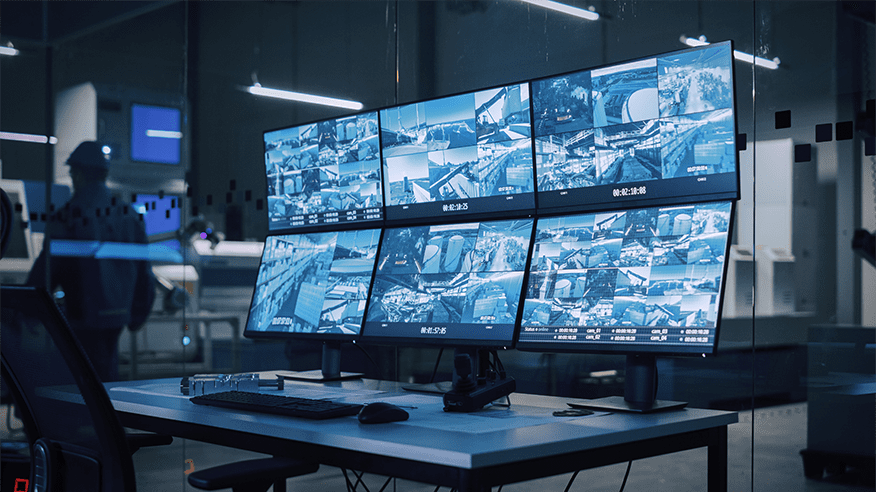
- Human Verification: Operators review short pre/post clips and recent access events; where speakers exist, issue calm voice-downs before dispatch.
- Evidence-Ready Exports: Standardized clip naming, time sync, and retention policies satisfy investigators and insurers.
Cyber-Physical Convergence: See the Whole Picture
Security events don’t respect org charts. Correlate camera alerts, badge anomalies, and network exceptions in one console; keep run-books that involve both physical security and OT/IT so responses are fast and coordinated.
Solar Sites: Miles of Fence, Minimal People, Serious Stakes
Energy facility security (solar, grid, substation) at solar farms is about coverage without over-staffing.
- Design for Scale: PTZs on high ground for wide area, fixed cameras at gates, combiner boxes, and O&M buildings.
- Patrols with Purpose: Directed tours target culverts, fence junctures, and access roads used by thieves scouting copper or panels.
- Weather-Ready Procedures: High-wind or storm mode keeps crews safe and ensures rapid site checks once conditions normalize.
Substations: Compact, Critical, and Attractive to Adversaries
Substations compress high-value gear—transformers, circuit breakers, relays—into small footprints. Your plan should be surgical:
- Delay Around Crown Jewels: Barriers and screening that limit line-of-sight to critical components without hindering maintenance.
- Camera Angles for Faces & Hands: Identify who, what, and how near gates and yard entries; keep lens heaters for fog and dew.
- Handoff Discipline: One-page escalation matrices define when to roll patrol, when to notify law enforcement, and how to preserve evidence for later regulatory or legal needs.
Control Rooms and Admin Buildings: Small Spaces, Big Consequences
- Visitor Control: Pre-registered visitors, single-use QR codes, and clear escort rules.
- Redundant Comms: Secondary radios and a “no-internet” phone tree for when networks are down.
- Continuity Run-Books: If a controller is locked out or a workstation fails, the playbook should be muscle memory, not a scavenger hunt.
The Five-Step Blueprint (Built for Busy Operators)
1) Profile Sites by Impact
Classify each property—remote solar array, urban substation, switching yard, O&M base—and note neighborhood patterns, approach roads, and historical incidents. Tie prioritization to business impact: outage exposure, restoration cost, and crew safety.
2) Engineer Time Into the Perimeter
Layer standoff and anti-ram elements, remove climbing aids, and re-aim cameras to eliminate glare. Confirm retention windows and time sync across VMS, access control, and alarm panels.
3) Write Short, Usable Run-Books
Two pages per scenario: Trigger → First 5 minutes → 60-minute plan → Stabilize. Include badge lockout steps, voice-down scripts, evidence capture, and police/fire liaison notes.
4) Train in Small Reps
Ten-minute table-tops—nighttime fence alarm, suspicious vehicle pacing the boundary, gate fault during shift change—build reflexes on all shifts, not just days.
5) Measure and Prove
Track KPIs that move the needle:
- Alert-to-Verify (sec)
- Verify-to-Dispatch (sec)
- On-Scene Arrival (min)
- False-Alert Reduction (trend)
- Repeat-Cause Fixes Closed (lighting, angles, signage, gate timing)
When these trend right, incidents fall—and your board and insurer see proof, not promises.
Common Gaps We Close Fast
Shadow Pockets and Glare
Solution: re-aim luminaires and lenses; add discreet, shielded fixtures; update camera housings with anti-fog and heaters for dawn/dusk clarity.
Contractor Credentials After Project Closeout
Solution: quarterly credential audits; automatic expiry; shared vendor playbooks with “least privilege” defaults.
“Cameras Worked, Evidence Didn’t”
Solution: standardize export workflows and clip naming; test monthly; maintain off-network backups for footage that must survive cyber events.
How CWPS Executes in the Field
- Directed Patrols: Must-hit checkpoints at gates, pad-mount transformers, and fence corners; geotagged with time stamps and photos.
- Live Monitoring + Voice-Down: Calm, clear audio messages reduce trespass dwell time; verified events route to patrol or law enforcement per thresholds.
- After-Action Packages: Time-stamped clips, badge logs, and short narratives support insurers, regulators, and law enforcement.
Planning a new site or hardening a legacy farm? Our Solar Farm Security guide covers panel-specific risks, long perimeter strategies, and patrol design that complement energy facility security (solar, grid, substation) across your portfolio.
Why City Wide Protection Services
- Proven Scale — 350+ properties protected; 65,000+ responses since 2016; 30+ verifiable life-saving interventions since 2020.
- Integrated Stack — Access & gate control, live video verification, K-9 (when appropriate), directed patrols, and evidence-ready reporting.
- Compliance-Aware — Programs designed to align with industry guidance (e.g., CISA substation practices and risk-based hardening methods).
Ready to Fortify Your Energy Sites?
Let’s build energy facility security (solar, grid, substation) that deters early, verifies quickly, and responds decisively—without slowing operations.
Call us: 888-205-4242
Email: [email protected]
We’ll map hotspots, tune analytics, stage posts, and publish KPIs that prove resilience is improving.