Modern property protection moves at the speed of data. That’s why License plate recognition security solutions SoCal property managers adopt today don’t just record— they trigger rapid response, guide patrol routes, and help resolve incidents faster. In this guide, we break down how LPR/ALPR (automated license plate recognition) works, where it delivers the biggest ROI across Southern California, and how City Wide Protection Services (CWPS) integrates LPR with live response, mobile patrols, and SOC monitoring.
Why LPR belongs in your layered security plan
When a vehicle enters a garage, HOA, campus, or industrial yard, ALPR cameras capture the plate, time, and GPS context. The data becomes searchable intelligence for security teams and, where appropriate, law enforcement partners. Research summarized by the National Institute of Justice indicates that visible, well-implemented plate readers can enhance deterrence and support targeted patrol effectiveness—key outcomes for high-traffic SoCal properties. You can read more about deterrence and patrol effects in the NIJ-linked study summary here.
In California, the technology is also governed by clear privacy rules. The Attorney General has advised agencies on lawful collection, training, and sharing obligations (including SB 34’s requirements), which is why reputable providers document policies, train users, and audit access. If you want the legal backdrop, see the AG’s guidance. California Attorney General
The SoCal use cases that get results
1) Multifamily & gated HOAs
Parking areas and community roads see repeat vehicles. With license plate recognition security solutions SoCal communities can match plates to resident lists, set alerts for trespassed vehicles, and surface repeat nuisance activity. CWPS can route mobile patrol cars to likely trouble spots and document interventions for management.
Related internal read: See how we manage gates and entries in our piece on San Diego Access Control Systems.
2) Commercial campuses & garages
Downtown towers, mixed-use centers, and medical plazas need frictionless access by day and strong deterrence after hours. With LPR tied into our Security Operations Center (SOC), after-hours hits on a watch list prompt real-time voice-down and dispatch.
3) Retail & logistics
Repeat shoplifters and cargo thieves rely on vehicles. LPR helps spot patterns (time of day, plates, and approach routes). That lets CWPS adjust proactive patrol timing and camera “hot zones” to get ahead of incidents rather than just documenting them.
4) Critical infrastructure & utilities
Substations, solar fields, and water facilities often span large perimeters bordering public roads. License plate recognition security solutions SoCal deployments give site managers a searchable record of approach vectors and can escalate response when plates match pre-defined lists.
How CWPS implements LPR—without creating noise
Evidence-driven policies and privacy
Well-run programs start with policy. Authoritative resources (like IACP’s ALPR policy guidance) emphasize training, access control, and data minimization—principles we follow when we design your program.
Clean watch lists & clear rules
Alert lists should be specific, time-boxed, and tied to an actionable SOP. For example: “If a plate associated with prior catalytic-converter theft returns after 10 pm, trigger SOC verification and send the nearest patrol.”
Human-in-the-loop verification
Camera hits route to our SOC where an operator validates the plate and context (vehicle type, direction of travel), checks for false positives, and only then dispatches field units or conducts a voice-down via speakers.
Integrated response—patrol + SOC + ALPR
ALPR has the most value when paired with mobile patrol and live camera monitoring. Our patrol cars (including hybrid police-style responders) receive alerts in real time and can intercept or deter quickly—often before an incident escalates.
What to measure (so you can prove ROI)
Hit quality (precision): Track the percentage of actionable hits after SOC verification (filtering out partial reads).
Response time: From first hit to patrol arrival.
Incident outcomes: Deters, interventions, and cases aided by LPR video/reads.
Resident & tenant experience: Reduced tailgating and parking abuse, fewer complaints.
Privacy & compliance: Annual policy reviews, user training completion, and audit logs (California’s SB 34 framework underscores these).
Deployment blueprint for SoCal properties
Step 1: Site and traffic study
We map ingress/egress points, light conditions, and approach speeds. Fast plates need shutter speed, angle, and IR tuning; garages need tight fields of view.
Step 2: Camera selection & placement
- Fixed lanes (garages, gates): dedicated ALPR cameras with IR.
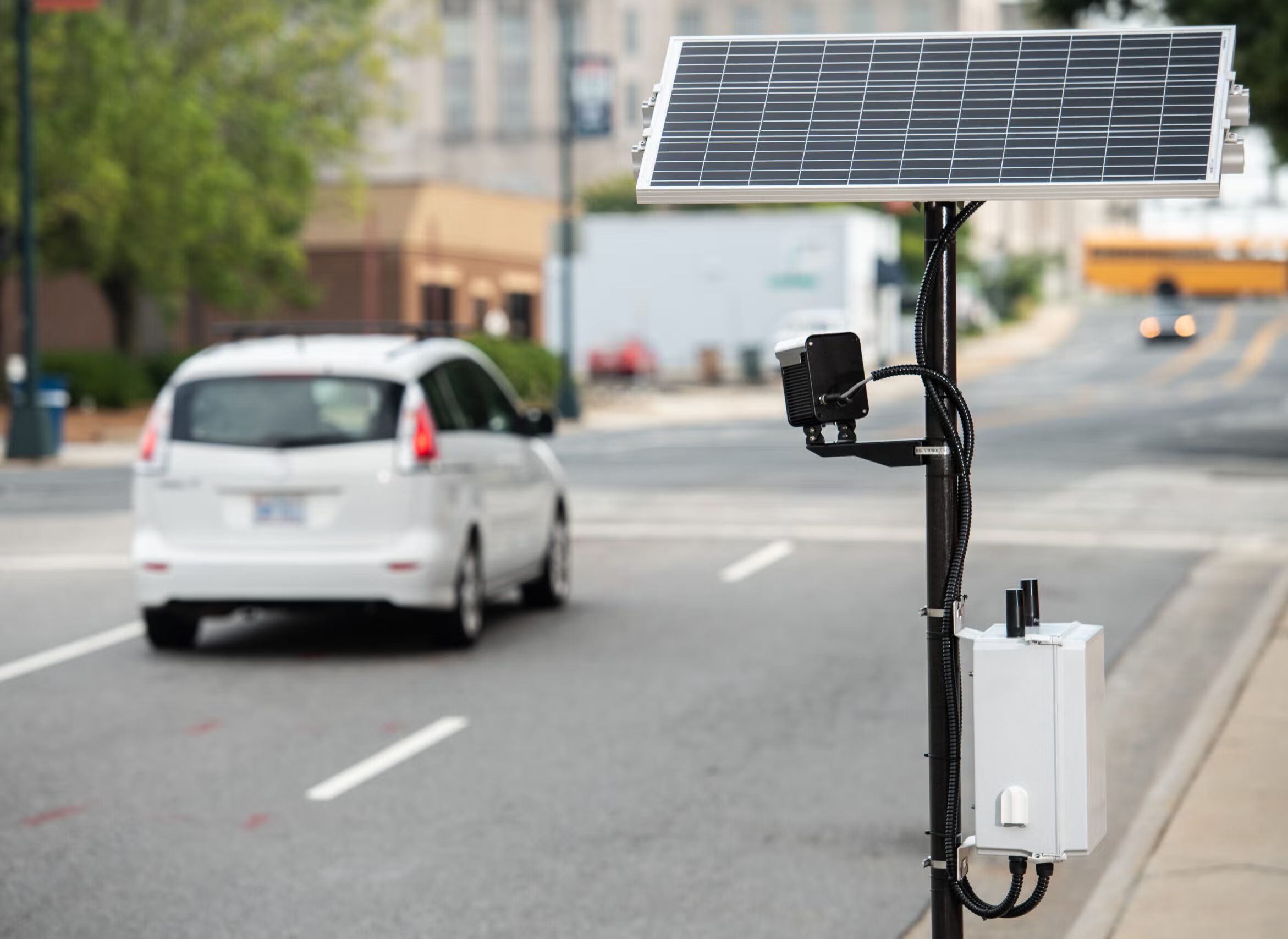
- Approach roads: pole-mounted ALPR with analytics zones to capture the plate before a turn.
- Patrol vehicles: mobile LPR units for roaming coverage across larger campuses.
Step 3: Data policy & retention
We align retention to risk and tenant expectations (shorter is generally better), restrict access to trained personnel, and enable searchable audit trails. California guidance stresses documented policies and training—which we implement and maintain.
Step 4: SOC playbooks & alerting
For each alert type (trespass, repeated nuisance, stolen vehicle flag), we pre-define the verification steps and dispatch rules. Integration with live camera monitoring and rapid response services means verified hits immediately translate to action.
Step 5: Patrol integration & reporting
Our SOC pushes verified alerts to patrol tablets. After each incident, clients receive a concise report with ALPR stills, video links, timestamps, and officer narratives—helpful for lease enforcement, insurance, and law enforcement follow-up.
Frequently asked questions
Is LPR legal in California for private security?
Yes—when used in compliance with applicable laws and strong privacy practices. We mirror public-sector best practices (policy, training, audits) and keep data within need-to-know scopes consistent with state guidance.
Will residents worry about privacy?
Transparency helps: post signage, publish a short policy, define retention, and give a clear point of contact. The IACP’s guidance outlines privacy-forward program design that we can adapt for your community handbook or tenant portal.
Does LPR actually reduce incidents?
Effectiveness improves when LPR is part of a layered plan—access control, lighting, patrols, and SOC monitoring. Studies in policing contexts show LPR can strengthen initial and residual deterrence; in private settings, we see similar benefits when alerts drive timely patrol action. Read the deterrence study summary here.
Get a tailored LPR plan for your property
Whether you manage a gated community in San Diego, a mixed-use center in Orange County, or an industrial yard along the I-5 corridor, CWPS can design, install, and actively respond on top of your LPR data.
Call us: (888) 205-4242
Email: [email protected]